
Why Nigerians are not returning home
Introduction of Philip Emeagwali by Emmanuel Oranika (as prepared for delivery)
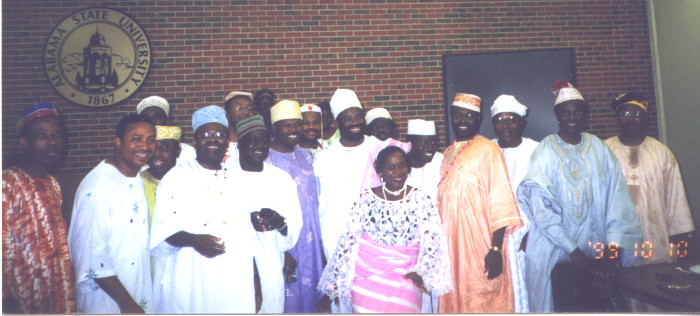
FRONT ROW: Dunni Adeyemo, Zephrinus Okonkwo, Emmanuel Oranika,
John Alak, Benjamin Datiri, Philip Emeagwali, Regina Okeowo, Paul Ehrunmwunsee, Lekan Ayanwale
BACK ROW: Edward Ademuyiwa, Doyin Ogunbi, Egbuna,
Adenrele Odutola, Lawrence Kromtit, and Christopher
Azubuike
Remarks, as prepared for delivery, to the Association of Nigerians
in Montgomery, Alabama on October 10, 1999
EMMANUEL ORANIKA: The oldest of nine children in an Igbo family, Philip Emeagwali (eh-MAY-ah-gwah-lee) was born in 1954 in the Yoruba town of Akure in southwestern Nigeria. During the course of the 1960s Biafran civil war, one million Igbos were killed and Emeagwali's family was forced to flee the terror. For 30 months, his family lived in a refugee camp and stood in line for free food. The war forced him to drop out of school, at age 12, and to work and support his family.
Realizing that education is his only way to escape from poverty, Emeagwali studied on his own from 6:00 a.m. to midnight. Eventually, he earned his high school equivalency diploma and passed the entrance examination to the University of London with top grades. He then emigrated to the United States to earn graduate degrees in mathematics, scientific computing; civil engineering, and ocean, coastal and marine engineering.
In the book "History of the Internet" (www.historyoftheinternet.com), Emeagwali was profiled as one of the pioneers that contributed to the development of the Internet. In particular, he was praised for demonstrating the power of the Internet for performing computations faster than those done by $30 million supercomputers.
Emeagwali has made 41 discoveries and inventions, such as the world's fastest computation of 3.1 billion calculations per second in 1989. He has won two dozen awards, including the 1989 Gordon Bell Prize (computing's Nobel prize).
Emeagwali's inventions has been positively reviewed in NBC's The Today Show, The Wall Street Journal, and The Guardian (London). The British Broadcasting Corporation (BBC) referred to him as "America's leading computer scientist." The Voice of America described his discoveries as beneficial to the U.S. petroleum industry. The Philadelphia Inquirer described him as "one of the greatest intellectual giants Africa has produced."
PHILIP EMEAGWALI:
THANKS.
Thank you, Dr. Oranika, for the very generous introduction. It was an introduction my mother will believe. Even if I believed only half of what you said, I will be flattered. The truth is that I have failed and succeeded in many things.
Thanks again for the pleasant introduction.
Good afternoon ladies and gentlemen. Yesterday was my first day in Alabama.
It is a pleasure to join you in this event. And I thank members of the
Association of Nigerians, Montgomery for inviting me to join you.
My visit to Montgomery is a special experience. Montgomery is the birthplace of the civil rights movement. You gave us Rosa Parks and Martin Luther King. Today, you have invited another civil rights pioneer, Gwendolyn Patton, to speak.
Last weekend, Nigerians celebrated the 39th anniversary of our
independence from Great Britain. I was in Washington, D.C. and
joined the Nigerian community in our Independence Day celebration.
I was surprised at the number and caliber of people that turned out for the party. I said to myself: "It seems like there are more Nigerian intellectuals living abroad than within Nigeria."
We had three Nigerian governors who spoke that night. Each of the governors came to the United States to seek technical assistance from the World Bank and the IMF.
I found it contradictory that the three governors were seeking
technical assistance from the World Bank but not from the Nigerian community.
According to the United States Census Bureau, Nigerians are the most educated ethnic group in the United States. Therefore, our leaders can seek technical assistance from Nigerians living in the United States. Sixty-four percent of Nigerians in this country has one or more university degrees. There are about 250,000 Nigerians living in the United States.
According to Dr. Emmanuel Oranika, half of the members of Association of
Nigerians, Montgomery have masters and doctorate degrees. That is a
reservoir of talents that Nigerian leaders are taking for granted.
We came to America to study. We planned to return home. But things got worse at home and we decided to remain in America.
It wasn't always like this. When Nnamdi Azikiwe arrived in the United States in 1924, there were only three Nigerian students in the entire United States. A hundred percent of those that came to the United States returned home. In fact, up till about 1980, most Nigerian students returned home
The widely held myth is that Africa is only exporting raw materials to the west. Africa is also exporting talented human resources to Europe and America. One million Africans are working outside Africa.
At the same time, Africa spends four billion dollars a year on the salary of 100,000 foreign experts. Yet, African nations are unwilling to spend a similar amount of money to recruit one million African professionals working outside Africa.
The problem is getting worse. One in three African university graduate live and work outside Africa. In effect, we are operating one third of African universities to satisfy the manpower needs of western nations.
One third of the African education budget is a supplement to the American education budget. In effect, Africa is giving developmental assistance to the United States.
There are more Sierra Leonean medical doctors in Chicago than in Sierra Leone. At the rate medical doctors are leaving Nigeria, we could eventually have more Nigerian doctors working outside Nigeria than within it.
We also need engineers to help provide constant electricity, clean water and safe roads. Here in Montgomery, one of the engineers that make sure that the people of Alabama has good roads is Dr. Emmanuel Oranika.
We also need scientists. We use science and technology to discover and recover petroleum. We use medical science to reduce infant mortality rate.
The world has changed a lot in the last fifty years. In today's world knowledge creates wealth. Therefore, we need people with brains, not muscles. Unfortunately, it is the best and brightest that can obtain visas to the United States. What is left behind is the least educated. This means that Africa will be getting poorer while the United States will be getting more affluent.
Put simply, Africa is exporting both natural and human resources. In the end, there will be no resources left within Africa. It means a slow death for Africa.
How can we reverse brain-drain? First, we build a data bank of
Nigerians abroad. Then, we offer them meaningful employment and
compensation that will entice them to return home.
Medical doctors cannot live on a salary of fifty (50) dollars a month. To make ends meet, some medical doctors raise poultry or manage beer parlor.
We need to change our national priorities.
We should stop spending one million dollars a day in fighting in Sierra Leone. One million dollars is greater than the daily salary of one million school teachers. While we are keeping peace in Sierra Leone, some teachers have not been paid their salaries for six months.
We must change our priorities be reducing our defense budget and increasing our education budget.
We must increase our investment in science, technology and education.
As we approach the end of this century, it is appropriate that we reflect on our legacy for our children. In the next century, it will be technological knowledge that will create wealth. Therefore, our legacy to our children will be the investments that we made on their education.
Thank you. You may ask me anything you like.
POSTSCRIPT:
Emeagwali's remarks were followed by a 45-minute question and
answer session, a four-hour party and a three-hour
informal discussions with leaders of the Nigerian community in Alabama.
On their way to the airport, Emmanuel Oranika discovered that he and Philip
Emeagwali were schoolmates at Saint Mary's High School, Ifite-Ukpo (near Onitsha) in 1967.
What a small world! The event was aired by the local NBC (October 9, 1999) and CBS (Oct. 10, 1999)
affilliates and written in The Montgomery Advertiser.
PHOTOS:

Mrs. Patience Oranika and her class students and Emmanuel Oranika (husband)
pose with Philip Emeagwali during his visit to Martin Luther King Elementary School, Montgomery, Alabama (October 9, 1999)

Philip Emeagwali's Q&A session, Martin Luther King
Jr. Elementary School, Montgomery, Alabama
(October 9, 1999).

Oranika family bid farewell to Philip Emeagwali
at the Montgomery, Alabama airport (October 11, 1999).
(L-R)Patience, Kenechi, Ifeoma, Philip, Chika and
Emmanuel


|Philip Emeagwali's
Website |
Do you want to book Emeagwali as your keynote speaker? Contact Dr. Donita Brown at 443-850-0850; fax/voicemail 413-521-3764; email [email protected]